
The ROI of AI search optimization is best measured as qualified pipeline per dollar spent, with an honest note on what that number leaves out. In the worked model below, a $5,000-a-month program creates about $315,000 of qualified pipeline in year one, 5.3 times its cost. Closed revenue is about $47,000, or 0.79 times cost, and the program pays back on closed deals in month 21. Traffic volume, lead rate and cost move that result far more than the 4.4x conversion premium everyone quotes. Every input is labelled, so you can swap in your own.
Key Takeaways
- Pipeline return and revenue return are different numbers. In the model they are 5.3x and 0.79x for the same program in year one.
- The 4.4x conversion premium for AI visitors is real in two datasets, but it multiplies a small base. LLM referrals ran at 0.73% of Google organic sessions across 100 sites.
- Clicks undercount the effect. Half of B2B software buyers start in a chatbot, and a shortlist formed there leaves no referrer behind.
- Every input multiplies the result, so a 2x error anywhere is a 2x error in the answer. Session volume and ramp time are the two you cannot know in advance.
- On the model’s inputs, a $5,000 retainer pays for itself in closed revenue only above about 38,000 monthly Google organic sessions. Below that, the case rests on shortlist presence you cannot prove.
Table of Contents
- Why is the ROI of AI search optimization so hard to measure?
- What model actually works?
- What benchmarks should you use for the inputs?
- What does a worked example look like?
- Which input changes the answer most?
- What should you report, and what should you ignore?
- Where does this model overstate or understate the return?
Why is the ROI of AI search optimization so hard to measure?
Because the most valuable thing AI search does happens before a click. A buyer asks a chatbot for a shortlist, reads three names, and later types one of them into Google or the address bar. Your analytics records a branded search or a direct visit and credits nothing to the answer that started it.
Semrush says as much about its own projections. Its July 2025 study of more than 500 topics modelled three leaks: AI clicks that arrive without referrer data and land as direct, buyers who navigate to the site by hand after reading an answer, and buyers who return later through branded search. None of the three shows up under an AI source in a standard report.
The demand side is large enough to take seriously. G2 surveyed 1,076 B2B software buyers in March 2026: 51% start research in an AI chatbot more often than in Google, up from 29% in 2025, and 69% chose a different vendor than planned because of chatbot guidance. In the 6sense 2025 Buyer Experience Report, 95% of winning vendors were already on the buyer’s Day One shortlist. Both are surveys, so they measure what buyers say they do, and both publishers sell to the people reading.

The consequence is awkward. The effect that matters most is the one your tracking is worst at seeing, and the effect your tracking sees best is small. A credible ROI model has to say which is which.
What model actually works?
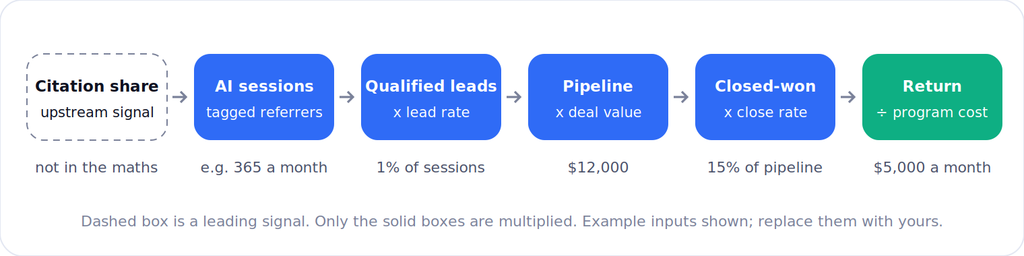
Use a chain you can inspect link by link. AI-referred sessions, times the rate those sessions become qualified leads, times your deal value gives qualified pipeline. Times your close rate gives revenue. Divide each by program cost and report both ratios, because they answer different questions and diverge sharply in year one.
- Pipeline return = (AI sessions × lead rate × first-year deal value) ÷ program cost
- Revenue return = pipeline return × close rate
One disagreement with common practice. WebFX publishes a GEO ROI formula that multiplies traffic by conversion rate by customer lifetime value. That works for a board slide and fails as a test, because lifetime value is the least observable number in a young company and it inflates every result. Use first-year deal value as the headline and treat lifetime value as a separate scenario.
Citation share is deliberately outside the maths. It is a leading indicator. A program can raise it and still produce nothing, if the prompts being won are not the ones your buyers type.
What benchmarks should you use for the inputs?
Use three sourced anchors and label everything else as your own assumption. LLM referrals run below 1% of Google organic sessions. AI visitors convert better than organic by a wide, disputed margin. Agency retainers start around $3,000 a month. Your deal value, close rate and lead rate must come from your own CRM, not from a blog.
The volume anchor is the sobering one. Marie Haynes analysed 100 websites over 12 months of GA4 data, more than 145 million sessions, and found ChatGPT sent 0.62% as many sessions as Google organic, or 0.73% with other LLMs added, as reported by MarTech on 22 October 2026. Among the 55 sites tracking conversions, 13.8% of ChatGPT visitors converted against 3.02% of Google organic visitors. Google organic still drove 27 times as many conversions as all LLMs combined. The study did not state its industry mix or how it defined a conversion.
Divide 13.8 by 3.02 and you get a premium of about 4.6x, close to Semrush’s 4.4x for AI visitors across digital marketing and SEO topics. Two independent samples agree on the quality. Neither helps with quantity. The premium is real, and it multiplies a very small number.
Cost is the third anchor. A June 2026 review of 20 agencies, summarised by DerivateX, put GEO retainers at $3,000 to $20,000 a month and one-off audits at $1,500 to $5,000. A $5,000 retainer sits inside that band.
| Input | Value in the model | Where it comes from |
|---|---|---|
| Google organic sessions | 50,000 a month | Assumption: a mid-size B2B SaaS site |
| AI-referred sessions at maturity | 365 a month | 0.73% × 50,000, using the Haynes ratio (MarTech, Oct 2026) |
| Session to qualified lead | 1% | Assumption. Replace with your CRM figure |
| Qualified lead to closed-won | 15% | Assumption. Replace with your CRM figure |
| First-year deal value | $12,000 | Assumption |
| Program cost | $5,000 a month | Assumption inside the $3,000–$20,000 retainer band (Red Engage via DerivateX, June 2026) |
| Ramp | No return months 1–3, 40% of maturity months 4–6, full from month 7 | Assumption. Not a measured timeline |
What does a worked example look like?
At 365 AI sessions a month, a 1% lead rate and a $12,000 deal, the program creates about $43,800 of pipeline a month once mature. Twelve months at $5,000 costs $60,000 and builds about $315,000 of pipeline, 5.3 times spend. Closed at 15%, that is about $47,000, or 0.79 times spend.
| Step | Calculation | Result |
|---|---|---|
| Qualified leads a month, mature | 365 × 1% | 3.65 |
| Pipeline a month, mature | 3.65 × $12,000 | $43,800 |
| Closed-won a month, mature | $43,800 × 15% | $6,570 |
| Full-weight months in year one | 3 × 0.4 + 6 × 1.0 | 7.2 |
| Year-one pipeline | 7.2 × $43,800 | $315,360 (5.3x of $60,000) |
| Year-one closed-won | 7.2 × $6,570 | $47,304 (0.79x of $60,000) |
| Break-even on closed deals | Cumulative closed-won passes cumulative cost | Month 21 |
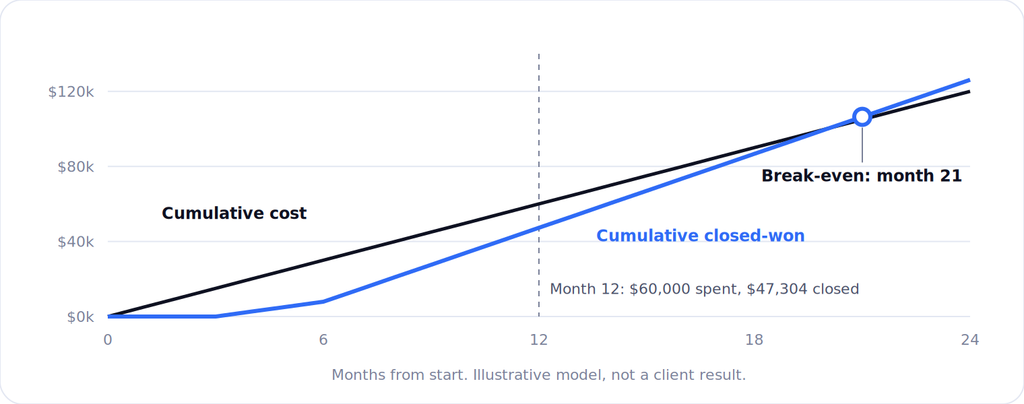
A 5.3x pipeline multiple looks board-ready. The same program has not paid for itself in closed revenue until month 21. Both statements are true, and a report that shows only the first is selling something. Pipeline is the number a growth team can be held to inside a quarter. Closed revenue is the number that decides whether to renew.
Which input changes the answer most?
All of them, equally, because the model multiplies them. A 2x error in any input is a 2x error in the result. What differs is how well you can know each one. Deal value and close rate sit in your CRM. AI session volume in month nine, and how long the ramp really takes, are guesses.
| Change one input | Year-one revenue return |
|---|---|
| Base case | 0.79x |
| AI sessions halved, or lead rate halved, or deal value halved, or cost doubled to $10,000 | 0.39x |
| AI sessions doubled, or lead rate doubled, or deal value doubled | 1.58x |
| Close rate 10% instead of 15% | 0.53x |
| Close rate 25% instead of 15% | 1.31x |
| Cost $3,000 a month instead of $5,000 | 1.31x |
Read the table the other way. The inputs you can pin down with your own data are the ones you will be off on by a little. The ones you cannot pin down can be off by half or double. Plan around the unknown ones with a range, and spend the first month measuring them.
What should you report, and what should you ignore?
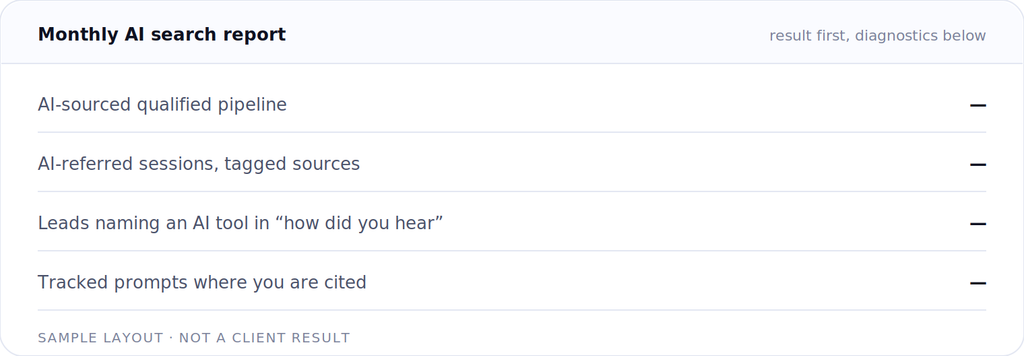
Report AI-sourced qualified pipeline, AI-referred sessions from tagged sources, and how many new leads name an AI tool when asked how they heard about you. Treat citation share and visibility scores as diagnostics, not results. They tell you whether the work is landing. They do not tell you whether it is paying.
The self-reported question matters because referrers miss so much. Add one open-text field to the demo form, “How did you hear about us?”, and read the answers monthly. It is crude and it is the only measure that can see a chatbot shortlist followed by a direct visit. This is our method preference, not a sourced benchmark, and it will undercount people who forget.
Ignore any ROI figure that does not show its inputs. If a vendor quotes a multiple, ask for sessions, lead rate, deal value, close rate and cost. If they cannot give all five, the multiple is a story.
Where does this model overstate or understate the return?
It overstates when the sessions you credit are people who already knew you and would have arrived anyway. It understates when AI answers shape shortlists that never produce a tracked click. It also ignores margin and lifetime value, which cut in opposite directions. Treat the output as a range, not a verdict.
Three limits are worth stating plainly. First, the ramp is an assumption. We found no independent source for how long it takes a B2B site to move from zero to steady AI traffic, so do not quote months 1–6 as a benchmark. Second, the model ignores sales-cycle lag. The 6sense report puts the average complex B2B buying cycle at 10.1 months, and any lag pushes break-even later than month 21 for larger deals. Third, the 0.73% ratio comes from 100 mixed sites, not from B2B SaaS specifically.
Then the part that costs us a sale. Run the same model for a site with 5,000 Google organic sessions a month. It yields about 36 AI sessions, 0.36 qualified leads and roughly $4,380 of pipeline a month at maturity, less than the $5,000 spend. For closed revenue to cover a $5,000 retainer at maturity, you need about 38,000 Google organic sessions a month. Below roughly 6,000, even the pipeline does not cover cost. If you are under those lines, do not buy this on click-based ROI. Buy it only if you believe in shortlist presence, and accept you cannot prove it yet.
Frequently asked questions
What is a good ROI for AI search optimization?
There is no independently verified benchmark. In the model above, year one returns 0.79x on closed revenue and 5.3x on pipeline, and both depend entirely on assumed inputs. One widely shared vendor write-up claims $340,000 of influenced pipeline from $19,500 in 90 days, a 17.4x return (Mersel AI, summarising GrackerAI, 2025). It is a single self-published case study and cannot be independently checked, so we do not use it.
How long before AI search optimization shows a return?
No source we found gives a reliable timeline. The model assumes no return for three months, partial return for three more, and full run rate from month seven, which puts break-even on closed deals at month 21. Treat those figures as a planning assumption you should test against your first 90 days of measured data.
Can GA4 track traffic from AI search?
Partly. Sessions from tagged referrers such as chatbot domains can be isolated in a report. Clicks that arrive without referrer data, visits typed in after reading an answer, and later branded searches usually appear as direct or organic, which is why Semrush’s own projections add a separate allowance for untracked traffic.
Is AI search optimization worth it if ChatGPT sends under 1% of Google’s traffic?
On clicks alone, often not, and the model shows why. The case for it rests on shortlists: G2 found 51% of B2B software buyers start in a chatbot and 69% switched vendors because of its guidance. That is survey data about behaviour you mostly cannot see in analytics. Weigh the two honestly and decide with a range.
How much does AI search optimization cost?
A June 2026 review of 20 agencies, summarised by DerivateX, found retainers from $3,000 to $20,000 or more a month and audits from $1,500 to $5,000. WebFX gives a wider range of $1,500 to $50,000 or more a month. Sub-$2,000 retainers rarely include citation tracking, which is the deliverable that shows the work happened.