

The short answer to AEO vs GEO vs SEO: SEO still produces most of the pipeline a B2B startup can actually count, while AI assistants increasingly decide which vendors make the shortlist before anyone clicks. So don’t pick one acronym. All three are parts of one job, AI search optimization. Treat AEO as a writing standard for every page, spend GEO effort only on buyer-stage prompts that name vendors in your category, and judge all three by qualified pipeline, not rankings or mentions.
Key takeaways
- AEO is not a separate budget line. It is how every page you publish should be written.
- Clicks from AI assistants are a small slice of traffic. The shortlists those assistants build are not, and your analytics can’t see them.
- A Google ranking is now an input to AI citation, not a guarantee of it.
- For a startup, GEO is mostly off-site work on review sites and communities, and it can’t be rushed.
Table of Contents
- What is the difference between AEO, GEO and SEO?
- AEO vs GEO vs SEO: how do they compare side by side?
- Which one produces pipeline you can count today?
- Where does AI search decide the deal before anyone clicks?
- Does ranking on Google still get you cited by AI?
- How should a B2B startup split effort across the three?
- When is AI search optimisation the wrong spend?
What is the difference between AEO, GEO and SEO?
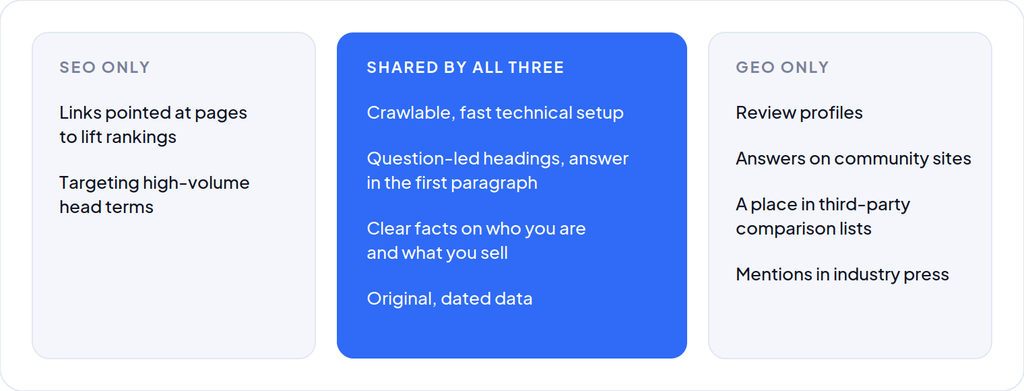
SEO earns a ranked link in search results. AEO, answer engine optimisation, earns the extracted answer: the snippet or AI Overview that answers the question on Google’s own page. GEO, generative engine optimisation, earns a mention inside an answer written by ChatGPT, Perplexity, Gemini or Claude. For a startup, all three run mostly on the same pages.
Don’t expect the industry to agree on those definitions. Nowspeed’s guide treats AEO as winning featured snippets and direct answers in traditional search engines, with GEO covering the newer AI platforms. Jasper’s 2026 guide puts Google’s AI Overviews under AEO and chatbots like ChatGPT and Claude under GEO. Plenty of agencies use AEO for anything involving AI.
That disagreement is useful information. The labels are marketing categories, not disciplines with separate methods. If a vendor quotes you three retainers for three acronyms, ask which tasks appear on only one of the three lists. The honest answer is short. Our guide to vetting an AEO or GEO agency has eleven more questions like it. We use the definitions above because they map to three real places a buyer meets you: a list of links, an answer on Google’s page, and a conversation inside a chatbot.
AEO vs GEO vs SEO: how do they compare side by side?
The three differ less in the work than in where the payoff lands and how you can measure it. SEO pays out in clicks you can attribute. AEO pays out on the results page, often with no click at all. GEO pays out inside a chat you never see, at the moment a buyer’s shortlist forms.
| SEO | AEO | GEO | |
| What you win | A ranked link | The answer shown on Google’s page | A mention inside a chatbot’s answer |
| Where the work happens | Your site, plus links to it | Your site: structure and wording | Mostly other sites: reviews, communities, lists |
| How pipeline arrives | A click, then a form | Brand recall, then a later search | A place on the buyer’s shortlist |
| How you measure it | Organic sessions and leads | Appearances in snippets and AI Overviews | Mentions on tracked buyer prompts, plus “how did you hear about us?” |
| What it asks of a startup | Months of publishing and links | A writing rule, applied to every page | Customers willing to review you, and patience |
Which one produces pipeline you can count today?
SEO, by a wide margin, because it still sends most of the visits your analytics can attribute. Visitors who arrive from AI assistants appear to convert at higher rates in every published study, but they remain a small slice of traffic. So on a startup’s dashboard, traceable search pipeline is still overwhelmingly organic.
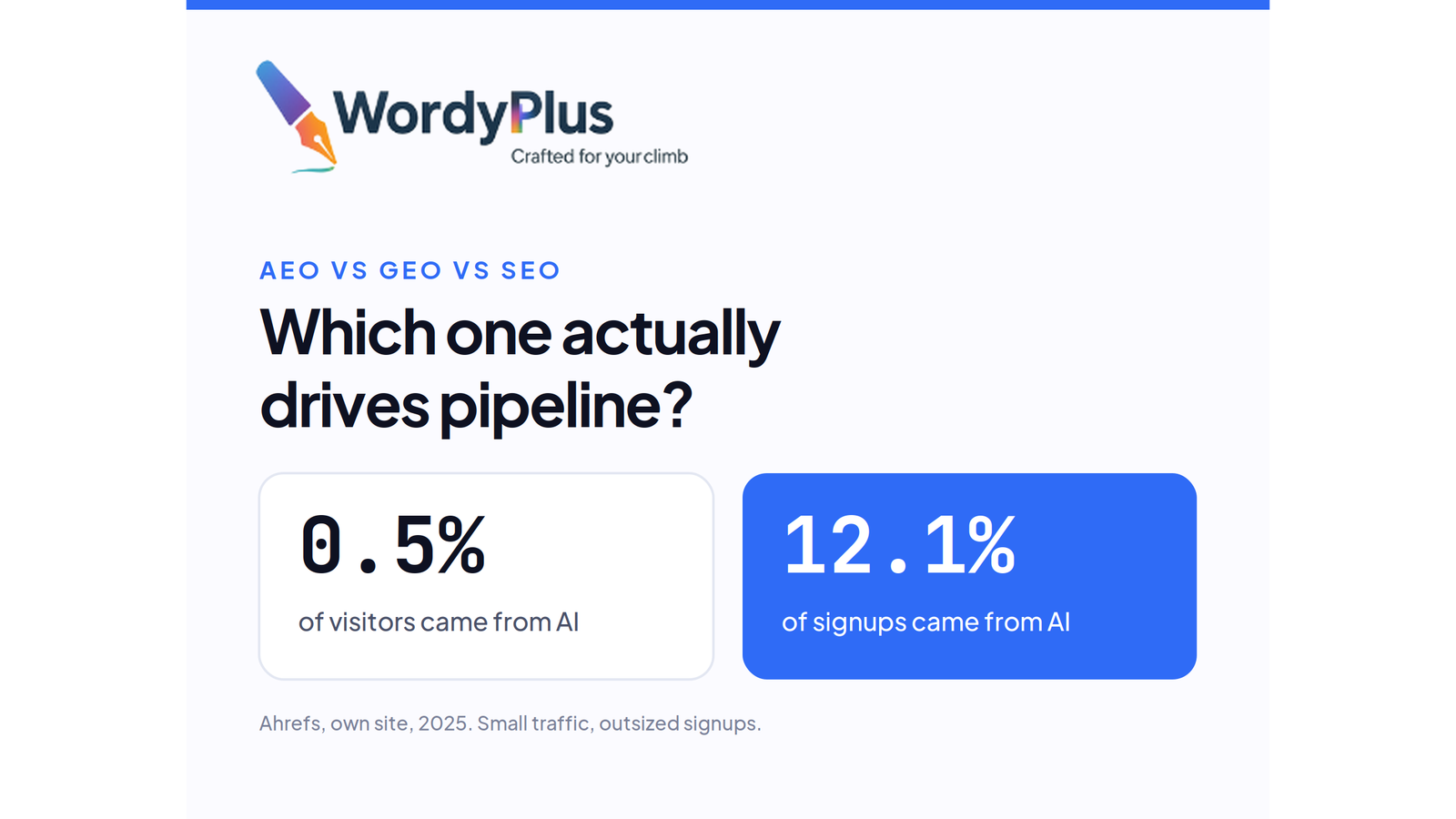
The two numbers everyone quotes both point the same way. Ahrefs reported that on its own site, AI search brought 0.5% of visitors and 12.1% of signups. A Semrush study from June 2025 put the average AI search visitor at 4.4 times the value of a traditional organic visitor, measured by conversion rate.

Read both with care. Ahrefs calls its figure anecdata, and it comes from one site whose buyers are marketers, the audience most likely to ask ChatGPT about SEO tools. Semrush sells AI visibility tracking. And the same Ahrefs article reports a study of about 82,000 sites in which AI visitors viewed fewer pages per visit than search visitors and bounced more often. That is not what a uniformly better audience looks like. Neither number is dishonest. Both are vendors publishing figures that flatter the category they sell into. The direction holds across studies; the size of the multiplier doesn’t, and anyone using 23x as a planning figure is planning on the ceiling.
Here is what it looks like at startup scale. This is a model, not measured data, so swap in your own numbers. Say you get 3,000 search sessions a month and 2% come from AI assistants: 60 visits. If organic visits turn into leads at 1% and AI visits convert 4.4 times better, organic brings about 29 leads and AI about 3. Even with the generous multiplier, traceable AI leads come to under a tenth of search leads.
Organic’s lead is shrinking from the other side too. In an Ahrefs study of 300,000 keywords, an AI Overview on the results page correlated with a 34.5% lower click-through rate. Rankings still bring clicks. Fewer of them.
None of this makes AI search small. It makes the clickable part small. The part that matters happens before the click, and analytics tools were never built to see it.
Where does AI search decide the deal before anyone clicks?
At the shortlist. G2’s March 2026 survey of 1,076 software buyers found 51% now start research in an AI chatbot more often than in Google, up from 29% a year earlier. A buyer who asks ChatGPT for the best tools in your category gets four or five names back. If yours isn’t one of them, there’s no click to lose.
The same G2 research says 71% of buyers use chatbots somewhere in their software research. According to G2’s announcement, 69% ended up choosing a different vendor than planned because of chatbot guidance, and a third bought from a vendor they had never heard of before.
That last number is the opening for a startup. AI answers are one of the few places an unknown company can land on the same list as the category leader. The catch is what the list is built from. G2 found that a review-site citation is the signal that most makes buyers trust a chatbot’s recommendation. And in its 2026 Buyer Behavior report, review sites (38%) edged past AI chatbots (37%) as the top source shaping which vendors make a shortlist.
G2 runs a review site, so weigh that accordingly. The mechanism still holds when you test it. Open ChatGPT or Perplexity and type the prompt your buyer would type. Not “what is [your category]”, but something closer to “best [category] for a 20-person fintech selling into the UK”. Then read the sources it cites. They will mostly be comparison lists, review profiles and forum threads. Your own “what is” post rarely shows up.
For a startup, GEO is mostly off-site work: review profiles, community answers, and a place in other people’s comparison lists. That is why it compounds slowly and why no sprint can shortcut it. You need customers willing to write reviews before you have reviews.
Does ranking on Google still get you cited by AI?
It helps, but it no longer guarantees it. In July 2025, Ahrefs found 76.1% of pages cited in Google’s AI Overviews also ranked in the top 10. By March 2026, counting all citations, that share was 37.9%. A top-10 ranking is now an input to AI visibility, not a stand-in for it.
Part of that drop is method, not behaviour. The 2025 study worked from a smaller set of citations per answer; the 2026 study counted every cited URL and found the rest split almost evenly: 31.2% ranked between 11 and 100, and 31.0% ranked beyond 100 or not at all. Ahrefs also changed how it parsed citations between the two, so they aren’t a clean like-for-like comparison. Even so, the direction is clear. Google’s AI answers pull from pages that aren’t on page one.
So SEO stays the base, and most of the work overlaps. The split looks like this.
How should a B2B startup split effort across the three?
Don’t split budget three ways. Fund SEO as the base, apply AEO as a writing rule to every page you publish, and add GEO only for the ten to twenty buyer-stage prompts that name vendors in your category. What changes with your stage is how much of this you do, not which acronym you buy.
The AEO rule is simple enough to write on a sticky note. Every heading is a question a buyer would type. The first 40 to 60 words under it answer that question completely, so the paragraph still makes sense if lifted off the page. Numbers carry a named source and a date. This post follows that rule, which is why each section opens with its answer. It costs discipline, not budget.
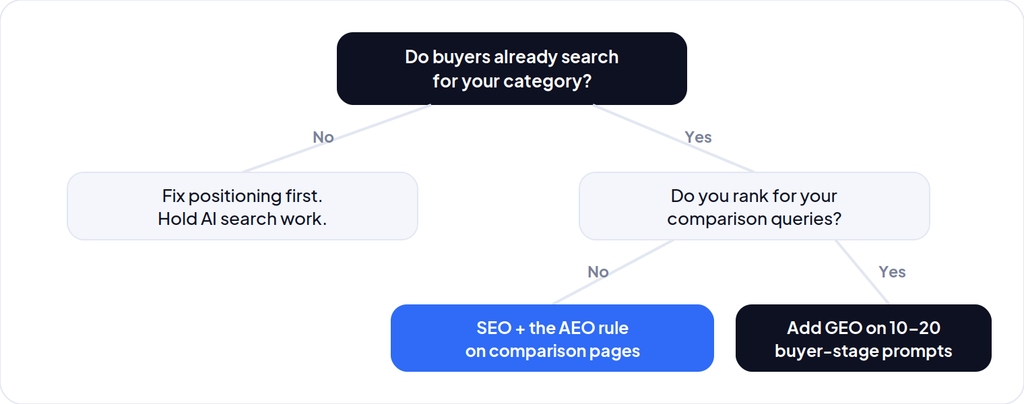
In practice, the AEO vs GEO vs SEO split plays out by stage. Before launch and your first ten customers, skip it unless buyers already search for what you sell. Work out who you’re for first. Between roughly 10 and 50 people, point SEO at problem and comparison queries rather than definitions, use the writing rule everywhere, and start GEO with the cheapest move available: complete review profiles and a list of the prompts your buyers ask. Check those prompts by hand once a month. Past 50 people, turn the prompt list into a tracked set against named competitors and run the off-site work as a programme.
The monthly check takes under an hour. Run each prompt in ChatGPT, Perplexity and Gemini, with a fresh chat each time. Note three things: whether you are named, which competitors are named, and which sources the answer cites. The third column is your GEO to-do list. If the same review site or comparison list keeps showing up and you are not on it, that is the next job. Answers shift between runs, so look for the pattern across a quarter rather than reacting to one bad week.
Measure all three the same way: qualified pipeline. Add one free-text field to your forms, “How did you hear about us?”. It catches the chatbot recommendations your analytics file under direct traffic, and it is the cheapest AI attribution tool there is.
When is AI search optimisation the wrong spend?
When buyers don’t search for what you sell yet, when they don’t research in chatbots, or when you can’t say in one sentence who you’re for. In each case the work buys visibility for a message that isn’t ready. AI assistants repeat an unclear message just as faithfully as a clear one.
A product creating a new category has no queries to optimise for; it needs founder-led selling and a name for the problem. A company selling into government tenders is bought through procurement portals, not chat. And a startup with five customers can’t build review profiles that compete with incumbents holding hundreds. It shouldn’t try to fake its way there either.
That applies to us too. If your positioning isn’t settled, WordyPlus would point you at positioning work before AI search, even though AI search is the service with the free front door.
Frequently asked questions
Is AEO the same as GEO?
Not by any agreed definition, and the vendors selling them don’t agree either. In practice both mean getting your content used inside an answer instead of listed under one. The on-page work is identical. The real difference is that GEO adds off-site work, because chatbots build answers from what other sites say about you.
Do I still need SEO if I focus on GEO?
Yes. In Ahrefs’ March 2026 data, 37.9% of pages cited in Google’s AI Overviews ranked in the top 10 for the same query, the largest single group. Ranking is no longer enough on its own, but pages nobody can find rarely get cited either.
How long does GEO take to show results?
There is no reliable published benchmark, and anyone quoting a fixed number of weeks is guessing. The slow part is off-site: reviews and third-party mentions build at the speed you win customers. Check your buyer prompts monthly and judge the trend over a quarter, not a single run.
Can I see AI search traffic in Google Analytics?
Partly. Visits from ChatGPT, Perplexity and similar tools show up as referrals you can group into their own channel. Clicks from Google’s AI Overviews can’t be separated from normal organic traffic; Ahrefs notes neither Search Console nor analytics tools distinguish them. A “how did you hear about us?” field fills the gap.
Which AI assistant matters most for B2B buyers?
ChatGPT, for now. G2’s April 2026 research found 63% of B2B software buyers use it for software research. Still test your prompts in Perplexity, Gemini and Google’s AI Overviews too, because each one cites different sources for the same question.
