
If you’re ranking on Google but not in AI answers, four things can go wrong, and they fail in a fixed order: the page doesn’t rank, the answer engine can’t read it, it reads the page but doesn’t cite it, or it cites you and still recommends someone else. You already rank, so the first is ruled out and the second takes minutes to check. For B2B software queries the evidence points at the fourth. In one analysis of Google AI Overviews, a brand’s own “best software” list was cited, yet the brand went unrecommended 69% of the time. Editing the page rarely fixes that. This post is part of our guide to AI search optimization.
Key Takeaways
- Ranking on Google but not in AI answers means you’re in the pool but not being picked. Ahrefs measured top-10 overlap with AI Overview citations falling from 76% to 38% between two studies, and BrightEdge found about 17%.
- Check rung 2 first. A nosnippet tag, copy missing from the raw HTML or a blocked crawler takes ten minutes to rule out and disqualifies the page if present.
- For B2B software queries the loss often happens at rung 4. In one analysis, Google cited a brand’s own list and still left the brand out of the recommendation 69% of the time.
- If the answer cites sources without naming you, read the pages it cites before you edit your own.
- Run each prompt more than once and log three things: sources shown, your domain cited, your brand named.
Is this your symptom?
You have this problem if you hold a top-ten position for a term your buyers use, and when you type the buyer’s real question into ChatGPT, Perplexity or Google’s AI Overview, rivals get named and you don’t. Search Console looks healthy. The gap only shows inside the answer.
Four statements, each specific enough to be wrong:
- You rank on page one for the head term, and the AI answer to that same question names three companies you outrank.
- Ask an engine about you by name and it describes you correctly. Ask for the best option in your category and you’re missing.
- Organic traffic is flat or rising, but prospects keep mentioning a rival an AI tool suggested.
- The same question returns different names on Tuesday and Friday.
The second one does the most work. If an engine knows you when asked by name and loses you on the category question, it can probably read your site, and your company exists in its picture of the market. Reading isn’t the problem. Selection is. That’s a rule of thumb, not a tested finding, so treat it as a place to start looking.
Why are you ranking on Google but not in AI answers?
Because the two systems pick sources differently. Google orders pages for the query you typed. An AI answer is built from several sub-questions the engine generates itself, and the pages that win those can differ from the page that wins your keyword. How far apart the two have drifted depends on which study you read.
Ahrefs found that 38% of pages cited in Google AI Overviews also ranked in the top ten for the same query, across 863,000 keywords and 4 million AI Overview URLs (March 2026). Its July 2025 study put that figure at 76%. BrightEdge, using a different dataset, reported about 17% in February 2026.
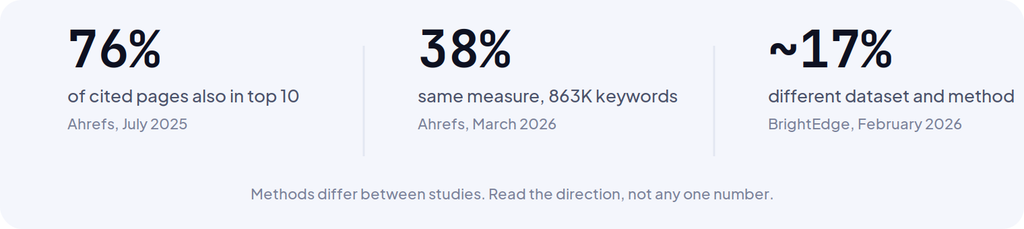
Don’t quote any single one of those numbers as fact. Ahrefs says its parsing improved between studies, so the two aren’t directly comparable, and BrightEdge measured differently again. The direction is the finding. Ahrefs also reports that 36.7% of cited pages didn’t rank in the top 100 at all, which fits the explanation that Google splits the query into sub-queries and cites the pages that turn up most often across them.
Rankings haven’t stopped mattering, and it’s worth saying so. A 2026 preprint on 1,006 pages, summarised by Prismic and not yet peer reviewed, found that pages at position one were cited in 43% of the queries where they appeared, against 5% at position seven. Ranking gets you into the pool. It doesn’t get you picked.
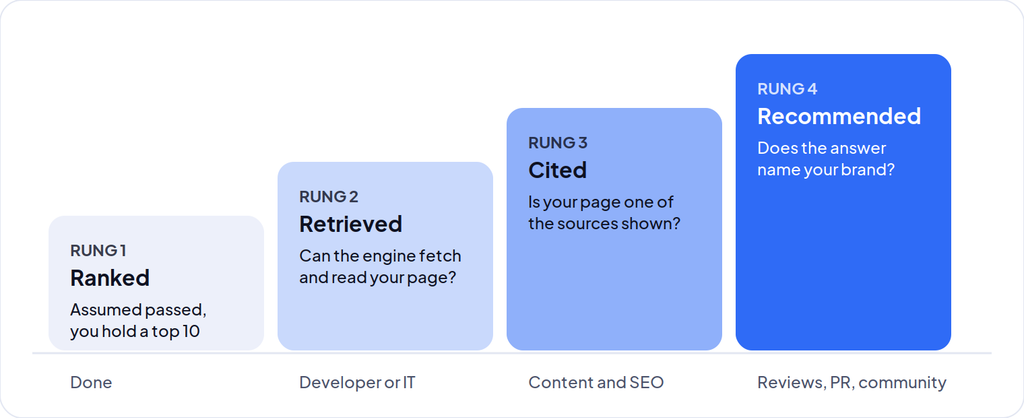
It helps to think of it as a ladder with four rungs. You’ve cleared the first. Each of the next three has a different cause and a different person who can fix it.
How do you tell which rung you’re stuck on?
Run your buyer’s actual question and open every source the answer shows. Three outcomes are possible: no sources at all, sources that don’t include you, or your page cited with your brand still unnamed. Each points to a different rung and a different owner, which is why rewriting the page first wastes the most time.
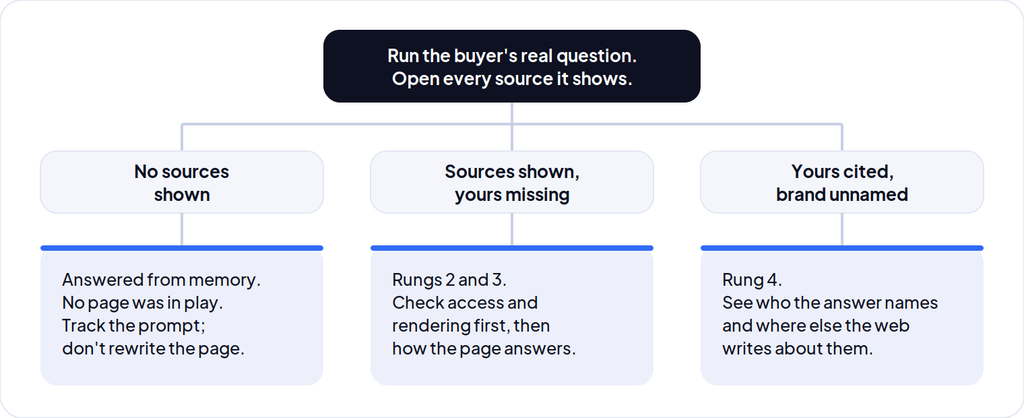
Run each prompt more than once. Ahrefs notes that the simulated sub-queries behind these answers change from run to run, so a single run is an anecdote. Then work the rungs in order, cheapest check first. For a fuller method, see how to check whether ChatGPT and Perplexity recommend you.
| Rung | The question | How to check | Who fixes it |
| 2. Retrieved | Can the engine fetch and read the page? | View source, robots.txt, snippet directives, CDN logs | Developer or IT |
| 3. Cited | Is your page among the sources shown? | Run the prompt, open every source | Content and SEO |
| 4. Recommended | Does the answer name your brand? | Same run, read the names | Whoever owns reviews, PR and community |
Could the engine even read your page?
Check three things, which takes about ten minutes: whether a nosnippet or max-snippet directive sits on the page, whether your body copy exists in the raw HTML, and whether robots.txt or your CDN turns AI crawlers away. Any one of them can disqualify a page however well it ranks or reads.
Google’s documentation says a page must be indexed and eligible to appear with a snippet to be shown as a supporting link in AI Overviews or AI Mode, with no additional technical requirements. A nosnippet tag added years ago to deter scrapers fails that test silently.
Rendering is the less certain one. Vercel and MERJ analysed more than 500 million GPTBot fetches in December 2024 and found no evidence of JavaScript execution. One site owner reported in September 2026, from their own server logs, that OpenAI’s bots had started rendering pages. That’s a single unverified account, so don’t plan around either answer. Open view-source and look for your first paragraph. If it’s there, move on.
Prismic’s August 2026 post covers these checks, and what’s known about each, in more depth than we will here. If your answer sits on this rung, read it and hand the fix to a developer. An afternoon’s work doesn’t need an agency.
Why do other companies’ pages get cited instead of yours?
For B2B software buying questions, the answer is often assembled from other people’s pages: review sites, forum threads, comparison lists and media. Several 2026 studies find third parties taking most citations, though they disagree on which third party leads. Your page is competing with what the rest of the web says about you.
Two small studies point the same way. BeVisibleIQ classified 2,391 citations from 75 B2B SaaS prompts in March 2026. In its 45 product queries on Perplexity, Gemini and Claude, 79.0% of citations pointed to a third-party site. Derivatex ran 40 buyer-intent category prompts through ChatGPT with search, ten times each, and found it cited a recommended tool’s own site 11.6% of the time. Both are agency studies with modest samples, so read them as signals, not benchmarks.
Which third party, though, is contested. A July 2026 analysis from GoGoChimp reported G2 supplying 55% of AI-cited SaaS references. Foundation Inc, covering 50 B2B brands and 57.2 million citations over 60 days, put Reddit first at 20.8% of external citations and G2 and similar review sites at about 4%. Same year, opposite answers. Prompt mix, engine and month all differ. What survives is the shared finding: someone else’s page usually does the work.
Then there is what Lily Ray found in Google’s AI Overviews. She tracked 100 B2B “best software” queries on three dates between April and June 2026. Of the 80 that triggered an AI Overview, self-promotional listicles were cited 323 times, and in 224 of those, or 69%, the brand that wrote the list was left out of the recommendation. Mind the limits. It’s one analyst, one engine and one kind of page, the self-ranked list, and she reads the pattern as depending on how established the brand already is. Even so, it shows that being cited and being recommended are different outcomes, and many diagnostics, a plain citation count included, measure only the first.
Here is the position we’ll defend. If you’ve passed the rung-2 checks and the answer cites sources without naming you, stop editing your own pages for a few weeks and read the pages being cited instead. The useful question is which of those pages you could appear in, and why you don’t. Someone could reasonably disagree: Google’s guide says AI features need nothing beyond what Search already requires, and most of Prismic’s evidence-graded fixes are on-page. We read both as compatible with this view, since ordinary SEO work includes becoming a company other sites write about. That reading is ours, and none of the studies above can prove it. How AEO, GEO and SEO differ in practice is the subject of our comparison.
For software sellers, buyer behaviour makes the effort worth it. G2’s March 2026 survey of 1,076 B2B software buyers found 51% start their research in an AI chatbot more often than in Google. Its July 2026 report, from 1,038 buyers, put review sites (38%) narrowly ahead of AI chatbots (37%) as the top influence on shortlists. G2 sells review profiles, so weigh the framing. The shortlist forms in both places, and both lean on pages you don’t own. We cover getting cited in buyer-stage prompts for B2B SaaS in a separate guide.
Start with a short list. Take the five to ten sources cited most often across your prompts. Sort them into review sites, comparison lists, forums and media. Mark where each competitor appears and you don’t. That list, not your meta descriptions, is the work queue.
What if none of these is it?
The engine may have answered from what it already knew, with no search at all, so no page could have won. In Prismic’s 30-day test, Microsoft Copilot answered 76.19% of how-to prompts without citing a source. Check whether your prompt returns sources before diagnosing anything else.
That was a single category, so the percentage is theirs, not a rule. ChatGPT and Perplexity cited sources every time in the same test, and brands were named in 90.9% of recommendation answers against 34.5% of how-to answers. The pattern is narrow but useful: informational prompts are likelier to come back bare, and buying prompts are likelier to come back with names.
So log what you see. For each prompt and engine, record three things on every run: whether sources appeared, whether your domain was among them, and whether your brand was named. As a worked example, ten prompts across three engines, run three times each, gives 90 answers. If you’re named in 9 of them, your mention rate is 10%. That’s arithmetic to show the method, not a benchmark.
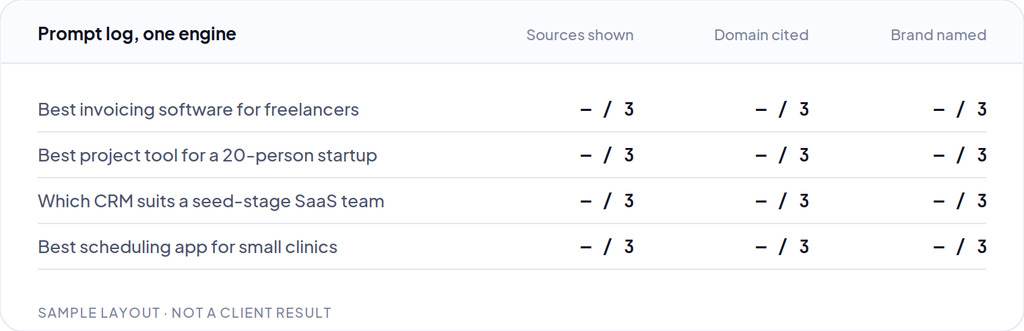
One more limit. From outside, you can’t see whether an engine used your page without citing it. A log shows what’s visible, which is also what a buyer sees, but it isn’t everything the model touched.
Where this diagnosis breaks
Almost everything above is vendor or analyst research. Ahrefs sells an AI visibility tool, G2 sells review profiles, and we sell an audit. Studies of the same question return numbers that differ by a factor of two or more, as the 38% and 17% figures show. Treat the direction as reliable and the percentages as rough.
WordyPlus has no published client results yet. Nothing here claims we’ve fixed this for anyone. It’s a reading of published research, and the way to check it is to run your own prompts.
If your buyers don’t research in chatbots, because sales run on referrals or procurement takes a year, the G2 data on software buyers may not describe them, and the gap between ranking and citation may matter less than this post suggests. And if your problem sits on rung 2, you need a developer and an afternoon, not us. If you do decide to hire help, these 12 questions expose fake AI search expertise.
Frequently asked questions
Does ranking on Google still help me get cited by AI?
Yes, but it doesn’t guarantee it. Ranking puts a page in the pool the engine draws from. Ahrefs found 38% of AI Overview citations came from the top ten, and a 2026 preprint found position-one pages cited in 43% of the queries where they appeared. Position helps. It isn’t the whole decision.
Why does ChatGPT name my competitors and not me?
For B2B software questions, answers are often built from third-party pages such as review sites, forums and comparison lists. In one study ChatGPT cited a recommended tool’s own site 11.6% of the time. Run your buyer’s question, open the sources, and see which pages name your rivals but not you.
Can I fix this by rewriting my page?
Only if the problem is on rung 2 or 3: the engine can’t read the page, or reads it and doesn’t cite it. If your page is cited and your brand still isn’t named, rewriting rarely helps. In Lily Ray’s analysis that happened 69% of the time for self-ranked lists.
How many times should I run a prompt before trusting the result?
More than once. Ahrefs notes the simulated sub-queries behind these answers change from run to run, so one run is an anecdote. Three runs per prompt and engine is our working rule, not a tested threshold. Log sources shown, domain cited and brand named each time.