

To check if ChatGPT recommends your brand, write 20 questions your buyer would ask without naming your company. Run each one in a fresh chat, five times, in ChatGPT, Perplexity, Gemini and Google’s AI Mode. For every answer, log whether you are named, who is named instead, and which sources are cited. Report the share of answers that name you. Never report your position in the list: in SparkToro’s January 2026 study, the same brand list came back less than once in 100 runs.
This is the audit step of AI search optimisation, written for the founder or first marketer at a B2B startup who typed their category into ChatGPT, did not see their company, and wants to know whether that means anything. One check means very little. A structured afternoon of checks means quite a lot. The whole checklist is below, including the parts an agency would usually keep for the sales call. If the terms AEO, GEO and SEO are still blurry, start with how the three differ.
Key Takeaways
- A single check is noise. AI tools almost never return the same list of brands twice for the same question.
- Your number is presence rate across all prompts combined. Rank inside one answer is meaningless.
- Check that the engines can reach your site before you check what they say about you. It is the cheapest fix and it blocks every other one.
- The sources an engine cites are the most useful output of the audit. They tell you exactly where you need to be mentioned.
- If nobody outside your own site has written about you yet, skip the audit. It will return zero and teach you nothing.
Table of Contents
- What does an AI visibility audit actually measure?
- What should you check first?
- How do you build the prompt set?
- How do you check if ChatGPT recommends your brand, and trust the result?
- What do Google, Bing and ChatGPT now report on their own?
- What can’t you check yourself?
- What do you do with the findings?
- When will the audit tell you nothing useful?
What does an AI visibility audit actually measure?
An AI visibility audit measures how often AI assistants name your company when a buyer asks about your category without mentioning you. It also records which competitors get named instead and which web pages the assistant relied on. It measures presence across many answers. It does not measure rank, because AI answers have no stable order to rank in.
The evidence for that last sentence is unusually good. In late 2025, SparkToro and Gumshoe had 600 volunteers run 12 prompts through ChatGPT, Claude and Google’s AI a combined 2,961 times, published in January 2026. The chance of ChatGPT or Google’s AI returning the same list of brands in any two of 100 responses was under 1 in 100. The same list in the same order was closer to 1 in 1,000.

The same study found something more useful than chaos. Which brands appear is fairly stable even when their order is not. City of Hope showed up in 69 of 71 ChatGPT answers about West Coast cancer hospitals, yet came first in only 25 of them. Presence carried the signal. Position was a coin toss.
One detail matters for B2B. When SparkToro’s panel asked for brand design agencies, a wide category with hundreds of plausible answers, the most-named agencies reached visibility only in the 30 to 40 percent range. Our reading, which the study did not test for your category: if you sell into a crowded B2B space, a presence rate in the teens may be respectable rather than a failure. Compare yourself to the competitors in the same answers, never to 100%.
Why bother at all? Because this is now where shortlists get made. G2’s March 2026 survey of 1,076 B2B software buyers found 51% now start their research in an AI chatbot rather than a search engine, and buyers ranked chatbots as the top source influencing which vendors make the shortlist. That survey covers software buyers. If you sell services, treat it as directional.
What should you check first?
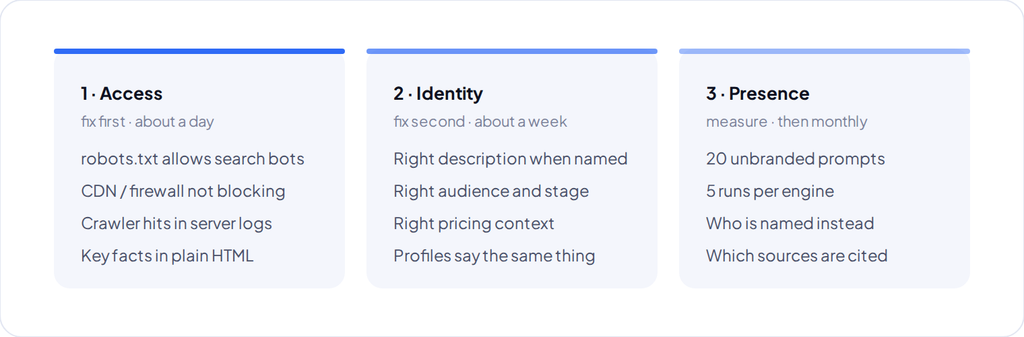
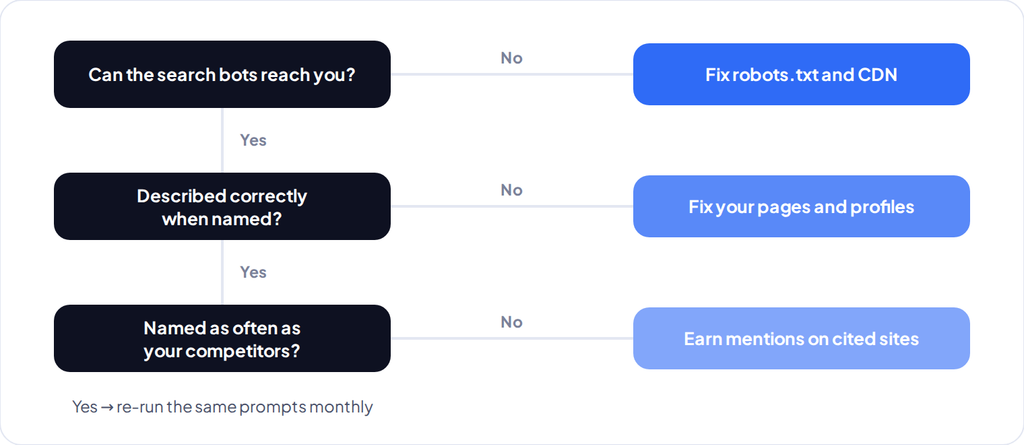
Check access first. It is the cheapest thing to fix and it blocks everything else: if the search crawlers behind ChatGPT and Perplexity cannot fetch your pages, no content or PR work gets you cited. Next, check whether each engine describes you correctly when you name yourself. Only then run the category prompts that measure presence.
The access check takes ten minutes. Open yoursite.com/robots.txt and look for two user agents. OpenAI’s crawler documentation says OAI-SearchBot is the one that surfaces sites in ChatGPT search, and that sites opted out of it will not be shown in ChatGPT search answers. It is controlled separately from GPTBot, the training crawler, so you can block training and still allow search. Perplexity’s documentation recommends allowing PerplexityBot for the same reason. Both say a change can take up to about 24 hours to register, so do not re-test five minutes after editing the file.
Then look past the file. Google’s guidance for its AI features says crawling must be allowed in robots.txt and by any CDN or hosting infrastructure. That second clause is where startups get caught. A bot-protection toggle on your CDN or firewall can refuse a crawler that robots.txt welcomes, and the file will never tell you. Check your CDN’s bot settings, and search your server logs for OAI-SearchBot and PerplexityBot requests in the last 30 days. No hits at all is a finding.
The identity check comes second. Ask each engine: “What does [company] do, who is it for, and roughly what does it cost?” If the answer is wrong, out of date or vague, fix that before anything else. An engine that misdescribes you when asked by name will not recommend you when asked by category.
How do you build the prompt set?
Write 20 prompts in your buyer’s words, five each across four kinds of question: category (“best X for Y”), problem (“how do I fix Z”), comparison (“X versus Y”) and fit (“which X suits a 15-person seed-stage team”). None may contain your brand name. Take the wording from sales calls, demo notes and support tickets, not from a keyword tool.
For a hypothetical startup selling SOC 2 compliance software, the four kinds might read like this:
- Category: “What are the best SOC 2 automation tools for a startup under 50 people?”
- Problem: “An enterprise prospect asked for our SOC 2 report and we don’t have one. What do we do in the next 90 days?”
- Comparison: “Is it cheaper to use compliance software or hire a consultant for a first SOC 2 audit?”
- Fit: “Which SOC 2 tool works for a team with no security engineer?”
Do not agonise over exact phrasing. SparkToro’s follow-up asked 142 people to write their own prompt for the same need, and the average semantic similarity between any two prompts was 0.081, which is to say almost nothing in common. Yet the brands that came back stayed largely the same. The engines resolve intent, not wording. Coverage of the four kinds of question matters more than getting any one prompt “right”.
Alongside the prompts, list the five competitors you actually lose deals to. Not the category leader you admire. The ones on the other side of your last five lost deals.
How do you check if ChatGPT recommends your brand, and trust the result?
Use a fresh chat every time, with memory and personalisation switched off, and run each prompt five times per engine. Log every answer on its own row. Then add up across all 20 prompts. The number that matters is the share of all answers that name you, per engine, set beside the same share for each competitor.
A fresh chat matters because an existing one remembers your earlier questions, and that memory can put your brand into answers a stranger would never see. Where the product offers a temporary or incognito chat, use it. Turn web search on in ChatGPT, because the sourced version of the answer is the one that tells you where its information came from. Perplexity shows numbered citations by default.
| Column | What to record | Why it earns a column |
| Date and engine | e.g. 30 Sep 2026, Perplexity | Answers drift. You need like-for-like next month |
| Prompt ID and run | P07, run 3 of 5 | Lets you total by prompt and by kind of question |
| Named us? | Yes / no | The raw input to your presence rate |
| Brands named | Every company in the answer | Gives each competitor’s presence rate from the same data |
| Sources cited | Every domain linked or credited | Shows which sites decide your category. This becomes your fix list |
| Accuracy note | Anything wrong said about you | A wrong fact in a good answer is still a problem |
The workload, as a model you can change: 20 prompts × 4 engines × 5 runs is 400 answers. At about a minute each to run and log, that is roughly seven hours. Halve the runs and you halve the time, and you also make the result much harder to trust.
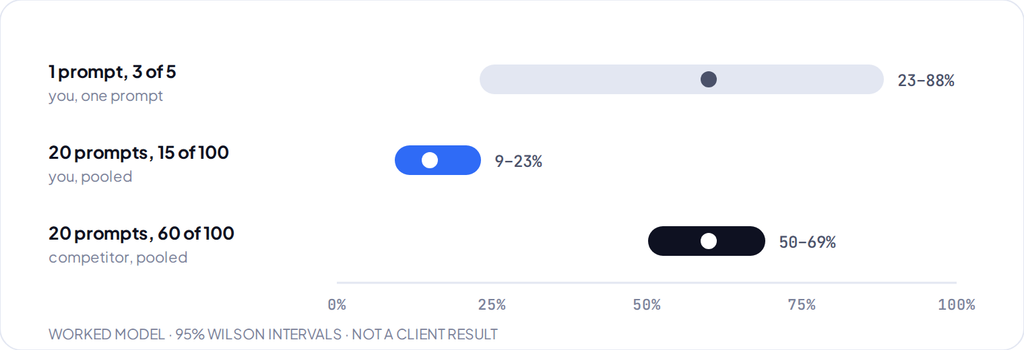
Two honest caveats on that arithmetic. Runs of the same prompt are not fully independent, so the real ranges are somewhat wider than the model shows. And pooling tells you about your category overall, not about any single prompt. If you need to say something about one specific prompt, SparkToro’s work suggests 60 to 100 runs, which is not an afternoon job.
What do Google, Bing and ChatGPT now report on their own?
Three free sources now show part of the picture. Google Search Console has a report of impressions inside AI Overviews and AI Mode, with no clicks. Bing Webmaster Tools shows how often Copilot cites your pages and for which queries. ChatGPT tags the clicks it sends, so they appear in your analytics. None of them shows you a competitor.
| Source | What it shows | What it does not |
| Google Search Console, generative AI report | Impressions in AI Overviews and AI Mode, by page, country, device and date. Announced 3 June 2026, rolling out to a subset of sites first | Clicks, the prompts behind the impression, competitors |
| Bing Webmaster Tools, AI Performance | Citations across Copilot, Bing’s AI summaries and some partner integrations, cited pages, and the grounding queries behind them. Launched in beta in February 2026 | A breakdown by surface, competitors |
| Your analytics (GA4 or similar) | Visits from ChatGPT, which adds utm_source=chatgpt.com to referral links | Answers where you were named but nobody clicked |
| Perplexity | We found no publisher report as of September 2026. Its numbered citations make the manual check easy | Any aggregate data |
Do not judge visibility by traffic. Conductor’s benchmark, reported by Search Engine Land, found AI referrals were 1.08% of all website visits, with ChatGPT sending 87.4% of them. IT was the highest industry at 2.8%. So a B2B startup seeing a handful of AI visits a month is normal. The traffic is the small, visible part of an answer that mostly gets read and not clicked.
What can’t you check yourself?
Three things are hard to do alone. You cannot practically run enough repeats to make claims about a single prompt. Mapping which sources drive each competitor’s mentions across hundreds of answers takes hours you do not have. And nobody can see the personalised answer a logged-in buyer gets, including us.
The first is arithmetic. Twenty prompts, four engines and 60 runs each is 4,800 answers. Tools exist to do this. Before paying for one, ask the vendor to show its method. Rand Fishkin’s conclusion from the SparkToro study was blunt: presence rate across many prompts and runs is a reasonable metric, and any tool selling you a “ranking position” in AI answers is not.
The second is patience more than skill. Your log already holds the sources. Turning 400 rows of domains into “these four sites decide our category, and here is what each says about the competitors” is tedious, and it is the part that tells you what to do next.
The third is a hard limit. A buyer who has used ChatGPT for a year gets answers shaped by that history. No audit, manual or paid, reproduces that. Anyone who says theirs does is guessing. If you would rather hire help than run this yourself, read how to vet an AEO or GEO agency before you sign anything.
What do you do with the findings?
Fix in order of cost. Access problems first, because they take a day. Wrong descriptions second, because they take a week of editing your own pages and profiles. Missing presence last, because it takes months: it depends on other sites mentioning you, and those sites are the ones the engines cited in your log.
The best available data points the same way. Ahrefs studied 75,000 brands and found mentions of a brand across the web had the strongest correlation with appearing in Google’s AI Overviews, at 0.664, ahead of the link and domain factors it tested. Two cautions. That is a correlation, not proof that mentions cause citations. And the study only included sites with a Domain Rating above 40, so it describes established brands, not a startup with twelve mentions. The direction probably holds for you. The size of the effect is unknown.
When will the audit tell you nothing useful?
If you are pre-launch, or almost nobody outside your own site has written about you, the audit will return close to zero. You knew that already. Spend the seven hours getting listed, reviewed and mentioned instead, and run the audit once there is something for the engines to find.
It will also mislead you in two other cases. If your buyers mostly arrive by referral or tender and never research vendors in a chatbot, a low presence rate is true and irrelevant. And if the audit shows healthy presence but your pipeline is flat, visibility is not your problem. Look at what happens after the click.
Our own audit has the same limits as the manual one. It samples answers, it cannot see a logged-in buyer’s history, and it can show you where the engines got their evidence but not why they chose one company over another. We would rather say that here than on a call.
Common Questions
Can I just ask ChatGPT whether it recommends my company?
No. Naming your company in the question tells the engine who you are, so it will usually find and describe you. That tests whether it knows you exist, not whether it picks you. Ask the buyer’s question without your name, and use the named question only for the identity check.
Does blocking GPTBot stop my site appearing in ChatGPT?
No. OpenAI treats them separately: GPTBot is the training crawler, and OAI-SearchBot is the one that decides whether your pages can appear in ChatGPT search answers. You can block training and still allow search. Blocking OAI-SearchBot is what removes you from search answers.
Are Google AI Overviews and AI Mode the same thing to check?
No. Ahrefs data from late 2025 found the two features cite different sources for the same query 87% of the time. A result in one tells you little about the other, so run your prompts in AI Mode and note separately whether an AI Overview fires on the matching Google search.
How often should I re-run the audit?
Monthly, with the same 20 prompts, the same engines and the same number of runs, so the months compare like with like. After a fix to robots.txt, wait at least a day before re-testing; OpenAI and Perplexity both say crawler changes take up to about 24 hours to register.

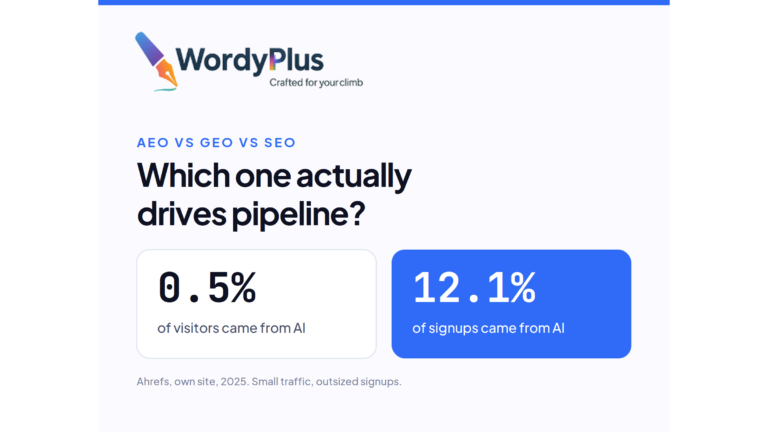
[…] Run each prompt more than once. Ahrefs notes that the simulated sub-queries behind these answers change from run to run, so a single run is an anecdote. Then work the rungs in order, cheapest check first. For a fuller method, see how to check whether ChatGPT and Perplexity recommend you. […]