
AI search optimization is the work of getting your company named inside AI-generated answers — ChatGPT, Perplexity, Google’s AI Overviews and AI Mode — and still ranked in the results underneath them. AEO, GEO and SEO are three labels for parts of one job. It matters to a B2B startup because the shortlist is assembled before anyone reaches your site: Forrester’s Buyers’ Journey Survey found 94% of business buyers used generative AI during their most recent purchase, up from 89% a year earlier. The number the work answers to is a count of durable citations in named sources, not a share-of-voice percentage.
Key takeaways
- AEO, GEO and SEO are one purchase with three labels. Buying them as three line items is how a startup pays twice for the same audit.
- “Does ranking still matter” has two opposite correct answers depending on the surface. In AI Overviews it carries most of the citation. In AI Mode it carries almost none.
- Off-site brand mentions predict AI visibility about three times more strongly than backlinks across 75,000 brands. Most of the work is not on your website.
- Share of voice is the wrong number. It moves when nothing has changed and every tool sells it. Count durable citations in named sources instead.
- Below roughly $3,000 a month the market sells four AI-drafted articles and a templated report. That is content, priced as a programme.
Table of Contents
- Is AI search optimization different from SEO?
- How do you know you have this problem?
- Has search traffic actually collapsed, or is that overstated?
- Does ranking on Google still get you cited by AI?
- What actually makes a brand get cited?
- What does the work actually consist of?
- What does it cost?
- How long does it take?
- What number should this answer to?
- Everything on AI search optimization
- When AI search optimization is the wrong thing to buy
Is AI search optimization different from SEO?
Partly, and the honest answer saves you money. The technical and content foundations are the same work. What is new is the measurement and the weighting: you count citations in named sources rather than tracking positions, and you fund off-site presence ahead of link building. AEO, GEO and SEO share one audit, one content plan and one off-site programme, which is why we sell them as a single service inside demand rather than as three.
Google’s own guidance, published in May 2026, says its generative features sit on top of the same ranking and quality systems as classic search, using retrieval-augmented generation and query fan-out to pull from the existing index (Google Search Central). Separating AEO from SEO is a useful diagnosis. As a purchase order it usually means paying two teams to fix the same broken schema.
| Label | What it optimises for | How it is measured | Where it gets oversold |
| AEO Answer engine optimization | Being selected as the answer to a specific question | Whether a passage of yours is the one quoted | Schema packages. Structured data is table stakes, not a programme |
| GEO Generative engine optimization | Being named inside a generated recommendation | Durable citations in the sources those answers draw on | Monitoring dashboards sold as the work rather than the measurement |
| SEO Search engine optimization | Ranking in the results underneath the answer | Position, and clicks on the queries that still send them | Content volume. More posts is the default prescription and rarely the diagnosis |
How do you know you have this problem?
The clearest signal is impressions holding steady or rising while clicks fall. Four others sit under it: you rank first for your category term and ChatGPT still names three competitors; prospects open sales calls with a comparison you were never part of building; GA4 “direct” traffic keeps rising and landing straight on pricing; and shortlists keep including a competitor you do not rate.
Each has a measurable version, and the backdrop is well documented.
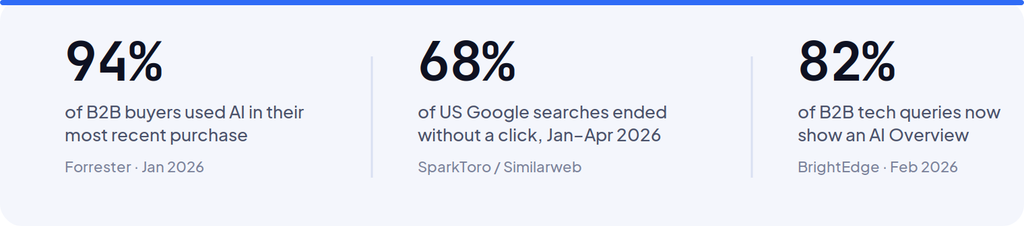
Zero-click behaviour is the backdrop. SparkToro’s analysis of Similarweb clickstream data found 68.01% of US Google searches ended without a click in the first four months of 2026, up from 60.45% in 2024 (Search Engine Land, June 2026). Ahrefs, comparing Search Console data across 300,000 keywords, put the CTR penalty on the top-ranking page at 58% when an AI Overview is present, up from 34.5% eight months earlier (Ahrefs, May 2026). B2B is not on the slow end: BrightEdge measured AI Overview coverage on B2B technology queries at 82% between February 2025 and February 2026, up from 36% the year before (BrightEdge data, compiled 2026).
Has search traffic actually collapsed, or is that overstated?
Overstated, in one specific way. The decline is real, but it is not a straight line down, and the clicks that survive are worth more than the ones that vanished. Anyone selling you this service on pure panic is skipping the part of the data that complicates the pitch.
Seer Interactive tracked organic CTR on AI Overview queries bottoming out at 1.3% in December 2025 and recovering to 2.4% by February 2026, while CTR on queries without an Overview rose from 2.8% to 3.8% (Search Engine Land, April 2026). Two things follow. AI Overviews are absorbing quick-answer traffic that was never going to convert, and the visitor who clicks anyway has already rejected the summary. Fewer sessions with better intent is a different problem from fewer sessions, and it needs a different response.
Does ranking on Google still get you cited by AI?
On AI Overviews, yes — 76.1% of cited pages already rank in the top 10. On Google’s AI Mode, no — 88% of citations do not appear in the organic results for the same query. Both figures are real, both are recent, and almost every guide on this topic quotes one of them and calls it the answer.
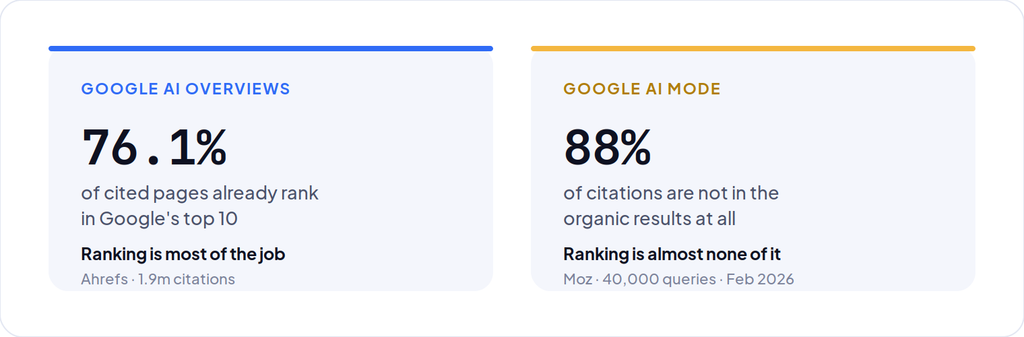
Ahrefs, studying 1.9 million AI Overview citations, found 76.1% of cited pages ranking in the top 10, with the top-cited URL sitting at a median organic position of 2 (Ahrefs). Moz, looking at nearly 40,000 queries in February 2026, found 88% of AI Mode citations absent from the organic results for the same query (reported by The Next Web, 2026).
The reconciliation is mechanical, not mysterious. AI Overviews are grounded in the index you already compete in, so they inherit your rankings. AI Mode runs a wider retrieval and leans on YouTube, Reddit, LinkedIn and niche authority sites, so it does not. Keep ranking, because that is most of AI Overview citation. Build off-site presence, because that is most of everything else. An agency that hands you only half of that sentence is selling the half it can already do.
What actually makes a brand get cited?
Being talked about somewhere other than your own website. Ahrefs analysed 75,000 brands and found the three strongest correlations with AI Overview visibility were all off-site brand signals, with backlinks — the metric a decade of SEO was organised around — coming last of the five tested.
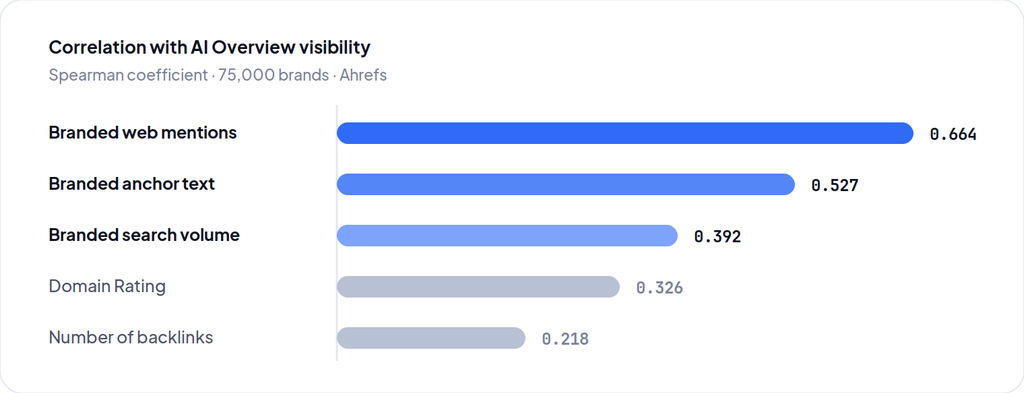
Branded web mentions correlated at 0.664, branded anchors at 0.527 and branded search volume at 0.392, against 0.326 for Domain Rating and 0.218 for backlink count (Ahrefs, 2025). The study covered brands with a Domain Rating above 40, so it says nothing reliable about a site starting from zero. Worth knowing before you treat it as a law.
There is a consequence of that finding almost nobody prices in. If answers are assembled from wherever your category is discussed, then which sources discuss you decides whether you exist. A company whose coverage, reviews and community presence sit mostly in its home market can rank perfectly well there and still be missing from an answer generated for a buyer in London or New York, because the sources that answer draws on have never mentioned it. That is not a content problem and more content will not fix it. It is a proof-density problem, and the fix is placement in the specific sources the answer already trusts.
What does the work actually consist of?
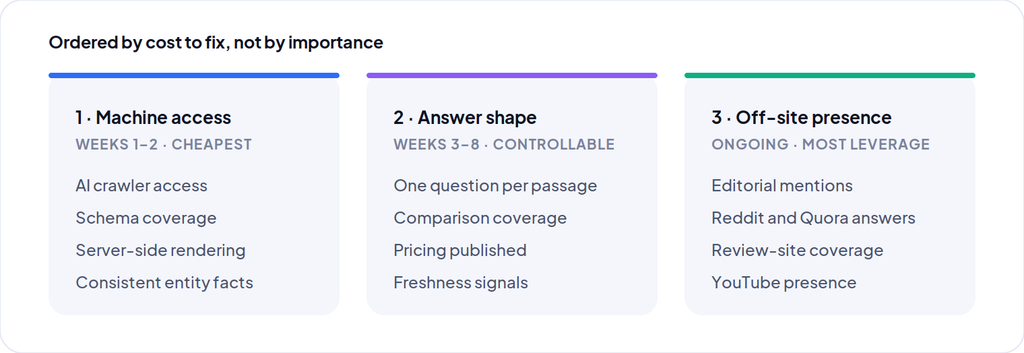
Three layers, done in that order: make the site machine-readable and your entity unambiguous, restructure content so one passage answers one question completely, then earn presence on the third-party sources these systems quote. The first layer is cheapest and unblocks the other two. The third carries most of the leverage and none of it happens on your website.
One thing to skip. llms.txt gets pitched constantly, and Google’s May 2026 guidance puts it under a heading called mythbusting: you do not need machine-readable files, AI text files or Markdown to appear in generative AI features. Ahrefs found 97% of llms.txt files received zero traffic in May 2026 across 137,000 sites (reported June 2026). It takes an hour. Nobody should be invoicing it as a deliverable.
What does it cost?
A one-off AI visibility audit runs $1,500 to $5,000 in the open market, and retainers run roughly $3,000 to $20,000 a month, with most mid-market B2B work landing between $5,000 and $10,000. Those come from Red Engage’s June 2026 review of published and quoted pricing across 20 agencies, which included three published tiers at $4,500, $7,000 and $14,000 (Red Engage, 2026).
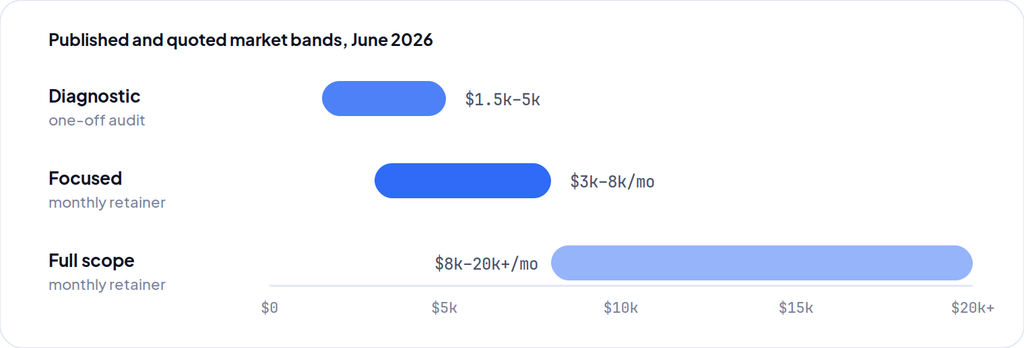
What moves the number is not how many engines get tracked. It is how many named competitors you benchmark against and how much placement work is in scope, because editorial coverage and community answers are labour and cannot be batched.
The floor deserves stating plainly. At $1,500 a month, after a normal agency margin, you are funding roughly 15 to 20 hours of junior time across your entire account. That buys articles. It does not buy a tracked prompt set, competitor analysis, schema work or a single placement.
How long does it take?
Technical and entity fixes land in two to three weeks. Citation counts typically start moving inside a quarter, provided the entity work was clean first. Off-site presence is the slowest layer, because you are waiting on other people’s publishing calendars rather than your own.
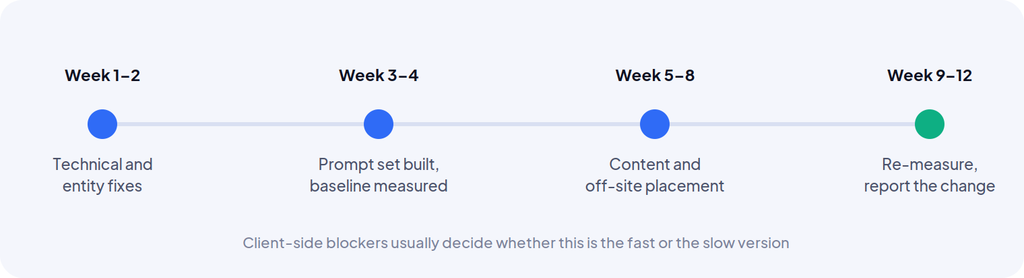
What slows it down is almost always on the client side: a developer queue that will not take schema changes, legal review on published pricing, or a founder who will not go on camera. Those are not excuses to plan around. They are the things to name in week one.
What number should this answer to?
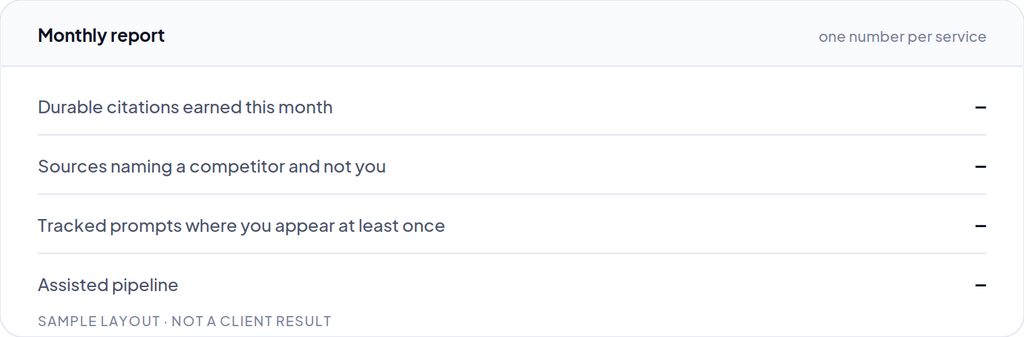
A count of durable citations earned in named third-party sources, reported monthly with the surface and the date. Not a percentage. A list you can open and read. Almost every tool in this category sells share of voice instead, and it is the wrong number for two reasons you can verify yourself in ten minutes.
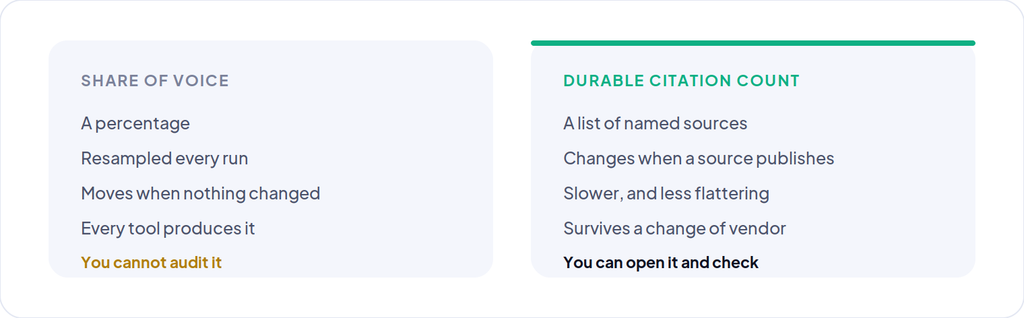
First, share of voice moves without anything changing. Ask the same prompt three times in three sessions and you can get three different brand sets back — a single run is one draw from a distribution, not a measurement. Second, every tool produces it, which means it partly measures the tool’s sampling rather than your visibility. A count of named sources that now mention you is slower and uglier, and it is the one your successor can verify.
Volume from these surfaces will look small next to organic, and that is normal. Semrush’s clickstream analysis found ChatGPT’s outbound referral traffic grew 206% comparing January 2025 to January 2026, even as the platform’s own visits plateaued near a billion a month (Semrush, 2026). Semrush also put AI-referred visitors at roughly 4.4x the conversion rate of standard organic, and Seer Interactive measured ChatGPT referrals converting at 15.9% against 1.76% for Google organic.
Read those multiples carefully, because they are the most misused numbers in this category. A visitor arriving from an AI answer has already been compared against your competitors and clicked anyway. The high conversion rate is partly the channel and largely the selection. Anyone quoting 4.4x as a forecast for your pipeline has misread their own source.
Track more than one engine while you are at it. A longitudinal panel of B2B referral data found ChatGPT’s share of measurable B2B AI referrals falling from 89% in mid-2025 to 62.6% by March–April 2026, with Claude at 18.5%, Gemini at 10.6% and Perplexity at 7.3% (Goodie, 2026). Optimising for one engine is a bet on a market that has already split.
Everything on AI search optimization
Ten deeper guides sit under this one, each answering a single question completely. They publish one at a time rather than all at once — thin pages across a wide tree are exactly the pattern these systems discount, which would be an unfortunate way to argue for our own expertise.
Cost and Return
AI search optimization pricing in 2026
What AEO, GEO and SEO cost a B2B startup, tier by tier, and exactly what sits in each.
Not yet published
The ROI of AI search optimization
A working model for pipeline from citations, with startup-realistic inputs rather than agency-flattering ones.
Not yet published
How long does AEO/GEO take to work?
A realistic 90-day timeline, week by week, including everything that delays it.
Not yet published
In-house vs agency vs AI SEO tools
The real alternatives, and the arithmetic showing where the threshold between them sits.
Not yet published
Diagnosis
AI search visibility audit
The whole checklist for testing whether ChatGPT and Perplexity recommend you, plus the checks needing account access.
Not yet published
Ranking on Google but invisible in AI answers?
Symptom, root cause and fix, in the order they should be worked rather than the order they get noticed.
Not yet published
Choosing an approach
AEO vs GEO vs SEO
Which of the three drives pipeline for a B2B startup, and where each one is the wrong place to spend.
Not yet published
How to choose an AEO/GEO agency
Twelve questions that expose fake AI search expertise, and what a deflection sounds like.
Not yet published
Best AI search agencies for B2B startups
Which of the three drives pipeline for a B2B startup, and where each one is the wrong place to spend.
Not yet published
AI search optimization for B2B SaaS
Getting cited in buyer-stage prompts, scoped to that segment’s constraints rather than generic advice.
Not yet published
When AI search optimization is the wrong thing to buy
You have fewer than ten customers. AI answers are assembled from what other people already say about your category and your company. If nobody has written about you and your positioning is still moving monthly, there is nothing to synthesise. Spend on positioning and first customers instead.
Your category has no prompt volume. Write twenty prompts a real buyer would type and run them. If the answers come back thin, generic, or refuse to name vendors at all, this channel is not ready for you and no amount of schema changes that.
You need pipeline in 30 days. This is a quarter-scale channel at minimum. If the runway conversation is that tight, paid ads and outbound are the honest recommendation, and we will say so on the call rather than after the contract.
You need published proof before you buy. WordyPlus does not have it. No case studies, no named client results, no redacted charts. That is a legitimate reason to weigh us against an agency with a public track record, and if it is your reason, you should. What we can do is hand over the method before you pay for the programme, which is what the audit is.
Common Questions
Do I need to hire anyone to check this?
No, and you should not until you have looked yourself. Open ChatGPT and Perplexity, ask the five questions a buyer in your category would ask, and write down which companies come back and which sources the answer used. That takes about twenty minutes and it will tell you whether you have a problem at all. What it will not tell you is why — for that you need crawler logs, schema validation and a prompt set run repeatedly, which is the part needing either tooling or someone doing it for you.
We already do SEO. Is this a separate budget?
It should not be a separate agency, and mostly it should not be a separate budget either. The technical work overlaps almost entirely. What changes is where the marginal money goes: away from link building and content volume, toward being mentioned in the third-party sources these answers draw on. If your current agency’s answer to AI search is more posts on your own domain, that is the conversation to have before you add a second vendor.
Why should I hire an agency with no published results?
You might not, and the section above says so plainly. What we offer instead of proof is the method in full before you pay: the free audit hands over the prompt set, the baseline and the fix list as a document you keep. If the findings turn out to be minor we will say that rather than propose a retainer. That is a worse pitch than a case study. It is the honest one available to us right now.
Should I add an llms.txt file?
Add one if you want — it takes an hour — but do not pay for it and do not expect anything from it. Google’s guidance lists machine-readable files like this under mythbusting, and Ahrefs found 97% of llms.txt files received zero traffic in May 2026 across 137,000 sites. Its real use today is helping AI coding tools parse developer documentation.
Not ready for an audit? The Demand overview covers how AI search optimization sits alongside paid ads and content, and which of the three to fund first at your stage.